Pickerel Frog
Lithobates palustris
Conservation Status:
State Status: Secure (NatureServe, 2024)
Global Assessment: Least Concern (IUCN, 2020)

Photographed by John Himmelman in Killingworth
Listen to call:
(Bethany Wilkinson, 2020)
Description
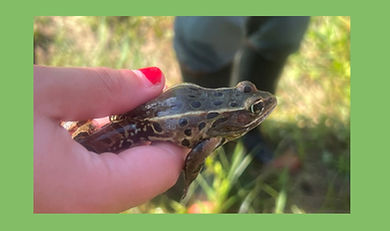
Pickerel frogs are around three inches long (Watkins-Colwell, 2024). They are most commonly brown, but can range from tan to green. This species has two rows of dark, rectangular spots down its back. Sometimes these spots will blend into each other, forming long lines. They have light dorsolateral ridges (the ridges that run from behind each eye down the back), and the underside of their legs are an orange or yellow. The stomach is white.
Habitat
These frogs are common around shallow aquatic areas. This might include streams, swamps, or ponds.
Behavior
Pickerel frogs will eat small invertebrates such as insects and arachnids. Predators may include snakes and small mammals. When threatened they will retreat into the water.
Breeding season occurs in the spring. Males will call out from shallow waters to attract females. Eggs are laid in clumps.
Range


Pickerel Frog
Photographed by Stephanie Campbel
Often Confused with

Northern Leopard Frog
Photographed by Eric M. Powell
The main difference between these two species is that the spots found on leopard frogs are round and appear randomly across their skin, whereas pickerel frogs have larger rectangular spots that come in two rows. Pickerel frogs have snouts that are more blunt, and a bright yellow coloring on the underside of their hind legs. They are typically a brown color while leopard frogs are green. The difference in coloration and spot pattern can clearly be seen in the images above.

Pickerel Frog
Photographed by Stephanie Campbel
Often Confused with
Atlantic Coast Leopard Frog
Photographed by John Michael Arnett
A big difference between these species is the pattern of their spots. Pickerel frogs have two rows of rectangular spots running down their back, while leopard frogs have circular spots that appear randomly. The differences in their spotting pattern can clearly be seen in the images above. Pickerel frogs also tend to have snouts that are more blunt and yellow coloring on the underside of their hind legs.
References
Bethany Wilkinson. (2020, September 10). Pickerel Frog Call. YouTube. https://www.youtube.com/watch?v=funJ5TbMadE.
iNaturalist. (2024). Observations. California Academy of the Sciences / National Geographic Society. https://www.inaturalist.org/observations?place_id=49&taxon_id=66002.
International Union for Conservation Of Nature and Natural Resources. (2020, December 21). Pickerel Frog. https://www.iucnredlist.org/species/58690/193376685.
NatureServe. (2024, November 1). Lithobates palustris. https://explorer.natureserve.org/Taxon/ELEMENT_GLOBAL.2.101857/Lithobates_palustris.
Quinn, D. P. (2020). Pickerel Frog. Connecticut Herpetology. https://www.ctherpetology.com/pickerel-frog.
Watkins-Colwell, G. J. (2024). Pickerel Frog - Rana palustris. Yale Peabody Museum. https://peabody.yale.edu/explore/collections/herpetology/guide-amphibians-reptiles-connecticut.
Watkins-Colwell, G. J. et al. (2006). New Distribution Records for Amphibians and Reptiles in Connecticut, with Notes on the Status of an Introduced Species. Sacred Heart University. https://digitalcommons.sacredheart.edu/cgi/viewcontent.cgi?article=1058&context=bio_fac.
Page updated November 20, 2024